Anthurium Magnificum
Anthurium magnificum
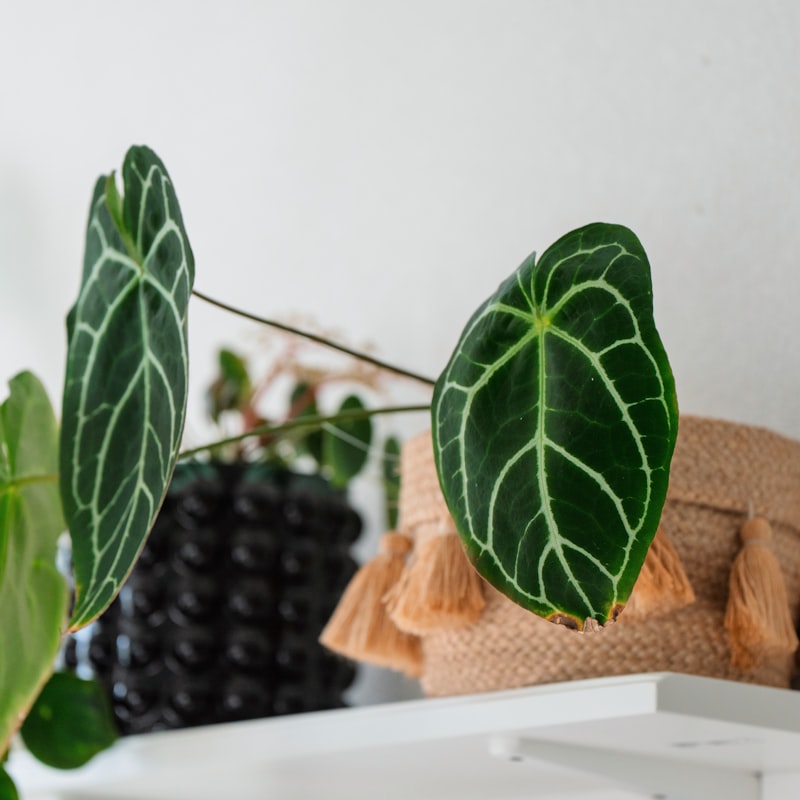
Dark velvety leaves with white veining that becomes more pronounced as the plant matures. The quadrangular petioles distinguish it from similar velvet-leaf anthuriums.
Buy this plant $55 In Stock- Light
- Bright Indirect
- Humidity
- 65-80%
- Temperature
- 65-82°F
Light Requirements
Bright Indirect. Place within 3-5 feet of a south or east-facing window, out of direct sun. Direct afternoon sun will scorch leaves.
Watering
Keep soil consistently moist during the growing season but never waterlogged. The top inch should be barely moist, not wet. Reduce frequency in cooler months. Use filtered or room-temperature water, not cold tap water.
Humidity
Target humidity: 65-80%. A room humidifier is the most reliable solution. Pebble trays and misting provide minimal benefit compared to a small ultrasonic humidifier near the plant.
Temperature
Keep between 65-82°F. Avoid cold drafts from windows in winter and hot air from vents year-round. Most tropical houseplants suffer below 55°F and should never be exposed to frost.
Soil and Potting
Well-aerated and chunky: orchid bark, perlite, and standard potting soil in roughly equal parts. Some growers add sphagnum moss for moisture retention. Target pH 5.5-6.5.
Propagation
Take a stem cutting with at least one node and 1-2 leaves, let the cut end callous for 24 hours, apply rooting hormone to the node, and root in a mix of sphagnum moss and perlite kept consistently moist. Division at repotting time is also reliable; each section should have at least 2-3 leaves and healthy roots.
Common Problems
Root rot from overwatering is the most common problem. Brown leaf edges indicate low humidity or overwatering stress. Stunted growth is usually caused by compacted soil, cool temperatures, or insufficient light.
Worth Knowing
- Anthurium magnificum was first described in 1865, making it one of the earlier Colombian aroids to enter European horticulture. It was grown in European hothouses throughout the late 19th century for exactly the same characteristics that make it popular today.
- The most reliable way to distinguish A. magnificum from similar velvet-leaf anthuriums is the petiole shape. A. magnificum has a distinctly quadrangular (four-sided, nearly square) petiole. A. crystallinum and A. clarinervium have round petioles.
- Many plants sold as magnificum in the trade are actually its hybrid with A. crystallinum or A. crystallinum itself. The hybrid produces large, round leaves with prominent venation and is very common in circulation.
Toxicity
Toxic to cats, dogs, and humans. Contains calcium oxalate crystals causing oral irritation, throat swelling, and GI upset if ingested.