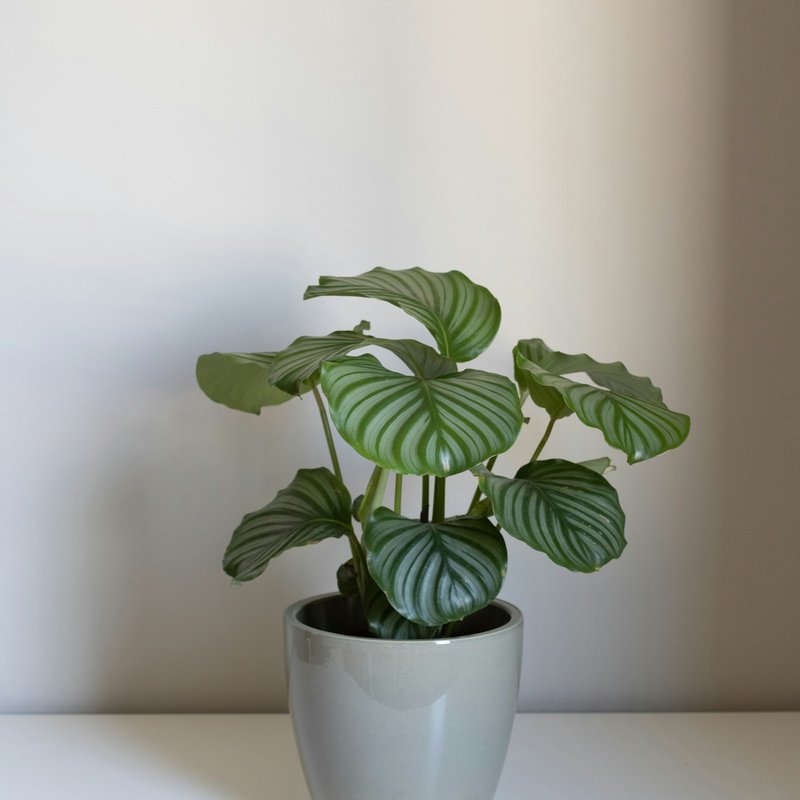
Calathea Orbifolia
Goeppertia orbifolia
The leaves actually fold upward at night, driven by specialized motor cells responding to light changes. We stock it seasonally because sourcing quality specimens is harder than the internet makes it look.
Buy this plant $22 Seasonal- Light
- Medium Light
- Humidity
- 60%+
- Temperature
- 65-75°F
Light Requirements
Medium Light. Works well in spaces that get indirect light most of the day. A few feet from a bright window, or near an east-facing window.
Watering
Keep the soil consistently moist but never waterlogged. Water once the top 2 cm has dried out. Here's the part most people skip: use distilled water, rainwater, or tap water left out overnight. Orbifolia is acutely sensitive to fluoride and chlorine, and it will give you brown leaf tips even when everything else is perfect. Don't ignore this one.
Humidity
Target humidity: 60%+. A room humidifier is the most reliable solution. Pebble trays and misting provide minimal benefit compared to a small ultrasonic humidifier near the plant.
Temperature
Keep between 65-75°F. Avoid cold drafts from windows in winter and hot air from vents year-round. Most tropical houseplants suffer below 55°F and should never be exposed to frost.
Soil and Potting
Loose and moisture-retentive without holding too much water. Mix 1 part coconut coir or peat moss, 1 part perlite, and 1 part vermiculite. Add clay pebbles at the bottom for extra drainage.
Propagation
Division at repotting time is the only option here, so don't wait hoping for another method. In spring, remove the plant, find the natural separations in the root ball, and gently pull divisions apart so each piece has roots and at least one stem. Pot in fresh moist mix and cover with clear plastic for 1-2 weeks while the roots settle in.
Common Problems
Brown tips almost always trace back to fluoride or chlorine in tap water, or humidity sitting below 60%. The Orbifolia will let you know within 24-48 hours if something shifted. Plant people have nicknamed this one Dramathea, and honestly it's earned it.
Worth Knowing
- Orbifolia's leaves fold upward at night. This is called nyctinasty, and it's driven by changes in turgor pressure in specialized motor cells at the base of each leaf. It's a little bit magical if you've never seen it happen.
- It's native to Bolivia, where it was formally described by botanist Helen Kennedy in 1982. That makes it a relatively recent arrival to botanical science. The whole genus was reclassified from Calathea to Goeppertia in 2012, which is why some nurseries still sell it under the old name.
- The nickname Dramathea exists for a reason. This plant will visibly react to a change in water quality within 24-48 hours. It's the most honest plant you'll own. Unfortunately it's communicating in brown tips.
Toxicity
Non-toxic to cats, dogs, and humans. One of the actually pet-safe options on this list.